Birendra Krishna Bhadra: The Voice Behind Mahalaya’s Mahishasura Mardini
Key Takeaways
- Birendra Krishna Bhadra (1905–1991) was the Bengali radio broadcaster, actor, and theatre director whose recitation of Mahishasura Mardini became inseparable from Mahalaya.
- He joined All India Radio in Kolkata in the early 1930s and lent his voice to the programme from 1937 onward, reciting the Chandi Path in Sanskrit.
- His pre-recorded 1966 narration is still broadcast every Mahalaya dawn, decades after his death.
- A brief 1976 attempt by All India Radio to replace him sparked public backlash strong enough to bring his voice back the following year.
- Today, his name is shorthand across Bengali households for the sound of Durga Puja’s arrival.
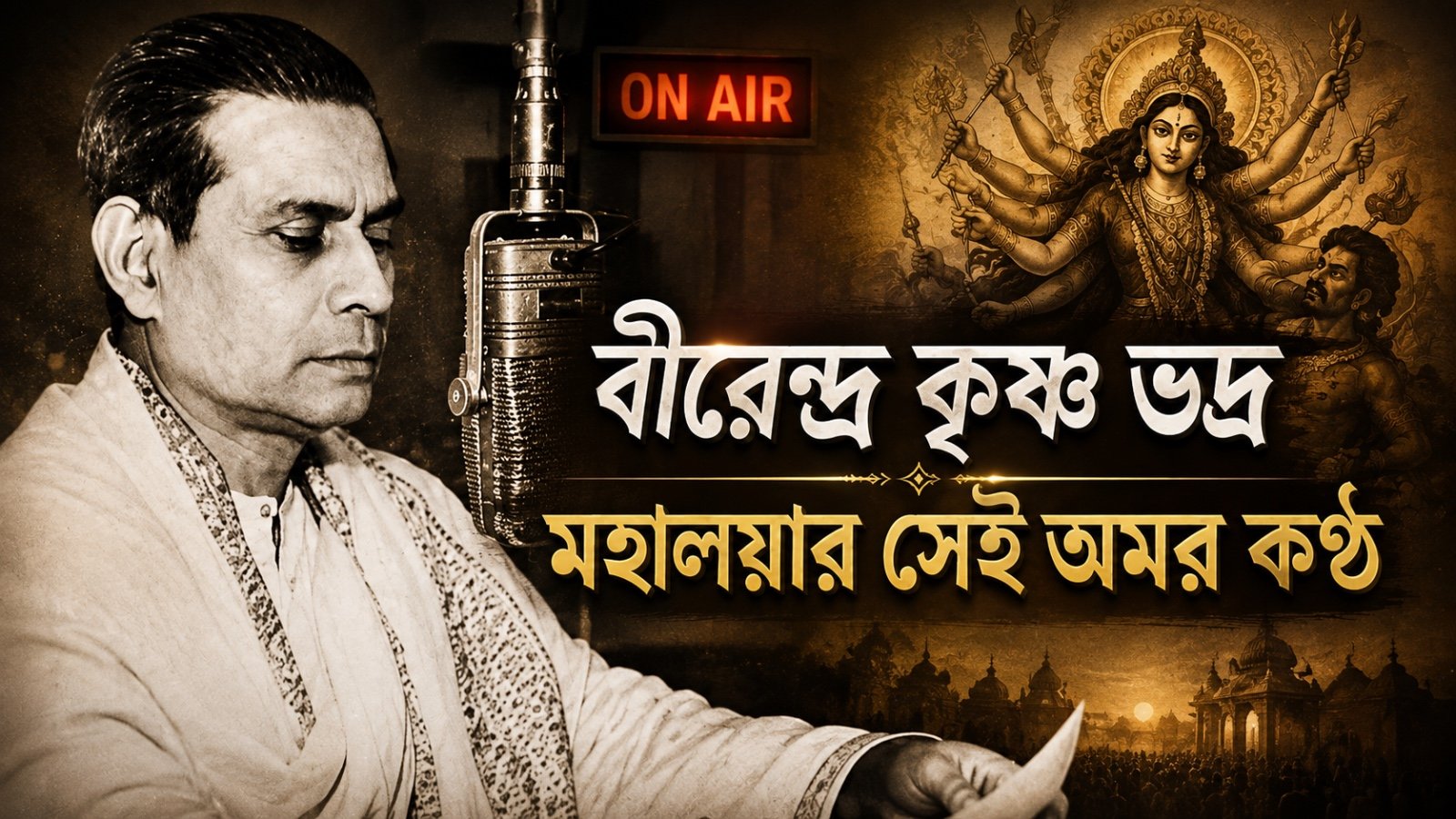
Ask any Bengali what Mahalaya sounds like, and the answer usually starts with one name: Birendra Krishna Bhadra. For nearly a century, his baritone recitation of the Chandi Path has opened the Durga Puja season on All India Radio, turning a pre-dawn broadcast into a shared ritual for millions.
Who Was Birendra Krishna Bhadra?
Birendra Krishna Bhadra was a Bengali radio broadcaster, playwright, actor, and theatre director, born on 4 August 1905 in Ahiritola, North Kolkata, and remembered above all for narrating the All India Radio programme Mahishasura Mardini. He passed away on 3 November 1991 in Kolkata, having spent close to four decades shaping Bengali radio drama and devotional broadcasting.
He grew up in a household steeped in language and performance. His father was a linguist and lawyer reputed to be fluent in more than a dozen languages, and young Birendra’s early exposure to Sanskrit and dramatic recitation came from within his own family. He later studied at Scottish Church College in Kolkata before drifting toward the stage and, eventually, the radio studio.
Entry into All India Radio
Bhadra joined All India Radio, Kolkata, in the early 1930s, initially working as a play director and adapting stage scripts for the still-young medium of radio drama. This was a formative period for Indian broadcasting, and Bhadra worked alongside other cultural figures of the era, including composer Pankaj Mullick and poet Kazi Nazrul Islam, as the station experimented with music, drama, and devotional content.
His grounding in Sanskrit recitation and stage performance made him a natural fit for a programme that would later define his career and, in many ways, define Mahalaya itself for Bengali listeners.
The Birth of Mahishasura Mardini
The programme that became Mahishasura Mardini did not arrive in its final form overnight. It began as an early-1930s radio drama at Kolkata’s Akashvani station, going through several titles and formats before the script, composed by Bani Kumar and drawing on the Devi Mahatmya’s account of Durga’s battle with the demon Mahishasura, took the shape audiences recognise today. The programme settled into its now-iconic Mahalaya morning slot in 1937.
Bhadra’s role was to recite the Chandi Path, the Sanskrit verses describing the goddess’s creation and her victory over Mahishasura, in a rich, resonant voice honed by years of stage training. In the programme’s early years, some conservative listeners objected to a non-Brahmin performer taking on a scripture recitation. That resistance faded quickly once the public heard him; his phrasing and emotional control made the broadcast feel less like a performance and more like a shared act of devotion.
The Voice That Became Inseparable From Mahalaya
By the mid-twentieth century, Mahishasura Mardini was no longer just a radio programme; it had become a fixture of Bengali domestic life. Families across Kolkata and beyond would wake before sunrise on Mahalaya specifically to hear Bhadra’s recitation, treating it as the unofficial starting gun for the Durga Puja season.
That bond between voice and festival was tested in 1976, when All India Radio replaced Bhadra’s narration with a new recording featuring different voices and personalities for that year’s broadcast. The reaction from listeners was swift and largely negative, and the original recitation returned the following year. The episode is often cited as evidence of how deeply the recitation had become woven into Bengali cultural identity, rather than simply being one broadcaster’s individual work.
From 1966 onward, All India Radio began using a pre-recorded version of Bhadra’s narration for the annual broadcast. That same recording has continued to air every Mahalaya morning since his death in 1991, meaning generations of listeners born after his passing have still grown up with his voice as the sound of the festival’s beginning.
Beyond the Microphone
While Mahishasura Mardini defines his public memory, Bhadra’s career extended well beyond a single broadcast. He worked actively in Bengali theatre as an actor and director, and he wrote the screenplay for the 1955 film Nishiddha Phal. His decades at All India Radio also involved producing and adapting numerous radio plays, work that helped shape the early grammar of Bengali audio drama.
Legacy and Cultural Memory
Birendra Krishna Bhadra’s influence on Bengali culture is unusual in that it rests almost entirely on a single annual broadcast, yet that influence has proven remarkably durable. His name and his recitation are frequently invoked in Durga Puja coverage, cultural retrospectives, and heritage storytelling, and his life was dramatised in the 2019 Bengali film Mahalaya, directed by Soumik Sen, which revisited the 1976 controversy and his broader legacy.
For a project documenting the stories behind Durga Puja, Bhadra’s life is a reminder that the festival’s cultural weight comes not only from pandals and idols, but from the people whose voices, rituals, and craft turn a religious observance into a shared cultural memory. Decades after his passing, the moment his recitation begins on Mahalaya morning remains, for many Bengali households, the true start of Durga Puja.