The River and the Goddess: Why the Ganga Is Central to Durga Puja
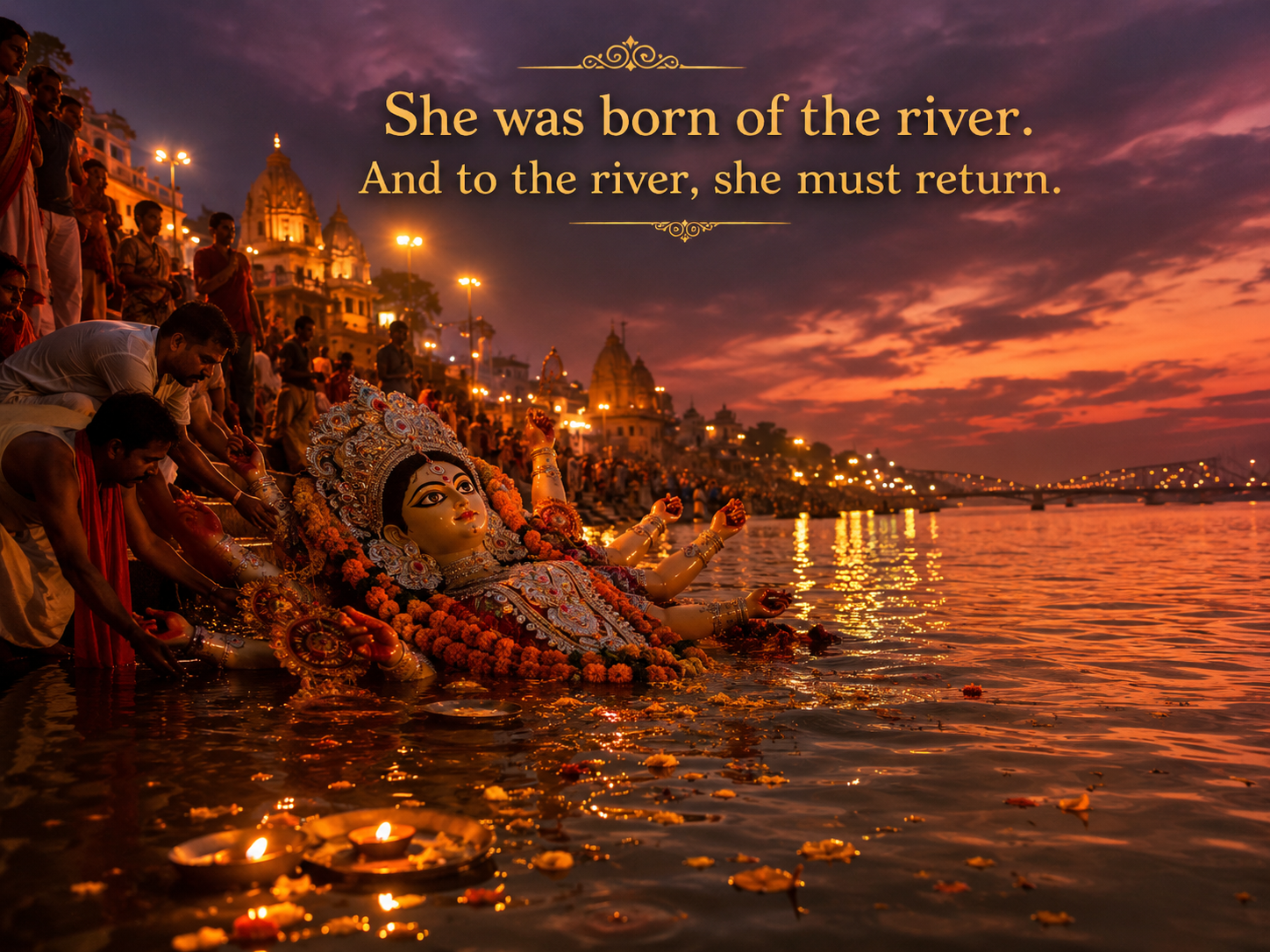
There is a moment, every autumn, when the noise of Kolkata seems to gather itself and walk down to the water. Drums lead the way. Marigolds litter the ghats. And a goddess who has spent five days draped in silk and gold is carried, gently, toward the Hooghly – the Ganga’s own arm reaching into Bengal – to be returned to the river she came from.
It is easy to see Durga Puja as a festival of pandals, lights, and processions. But underneath the spectacle runs a quieter logic, one written in mud and water long before the first drumbeat sounds. The Ganga is not a backdrop to Durga Puja. She is its first and last collaborator – present at the goddess’s making, her worship, and her going.
Clay From the River: How the Goddess Begins
Months before Durga Puja begins, in the narrow lanes of Kumartuli, Kolkata’s potters’ quarter, artisans walk down to the banks of the Hooghly. On Akshaya Tritiya, an auspicious spring day, they gather riverbed clay – the same silt the Ganga has carried down from the Himalayas for millennia – and begin building the goddess from the ground up: bamboo and straw first, for bone and breath, then layer upon layer of soft clay for skin.
This is not incidental material. Different families in Kumartuli own different workshops, each developing its own particular style, but the clay for the sculptures is traditionally collected from the banks of the Ganges on Akshaya Tritiya. The goddess is, quite literally, made of riverbed.
There is a second, more startling ingredient. Tradition calls for a handful of soil from the doorstep of a brothel to be mixed into the clay – a substance known as punya mati, or “blessed soil.” The custom has no clear documented origin, but its logic has been passed down for generations: the priest must visit a sex worker’s home and beg for this soil, and if she refuses, he is to keep asking until she gives it willingly. One widely offered explanation holds that the practice asserts inclusivity – that even those a society marginalizes and shuns hold a sacred place in the eyes of the divine. Whatever its true roots, the ritual insists that no soil, and no person, is too profane to enter the body of the goddess. Earth from the riverbank and earth from the city’s most overlooked corner are folded together – and only then does Durga begin to take shape.
By the time the idol is ready, she carries the Ganga inside her before a single prayer is spoken over her.
A Goddess Born of the Same River
This is fitting, because the Ganga is not a minor figure in this story – she is herself one of Hinduism’s great goddesses, and her own myth runs in a kind of parallel current to Durga’s.
According to the Puranas, Ganga lived first as a river of heaven. King Bhagiratha performed extraordinary penance to bring her down to earth, hoping her waters could free the souls of his ancestors. Brahma granted the wish, but Ganga’s descent threatened to shatter the world with its force, so Shiva caught her in his matted hair, taming her power before releasing her as a gentler, life-giving river. The place where she first touched earth, Gangotri, remains one of Hinduism’s most sacred sites to this day.
That story matters here for a simple reason: in eastern Indian tradition, Ganga is understood as Parvati’s sister – both daughters of the Himalayas, both in some sense bound to Shiva. The Ramayana describes Ganga as the firstborn of Himavat, the personification of the Himalayas, making her sister to the mother goddess Parvati. Durga, in her Bengali homecoming narrative, is understood as a form of that same Parvati, returning each autumn from her husband’s home in Kailash to visit her parents on earth. So when Durga arrives, she arrives, in a sense, to her sister’s house. The river that receives her at the end of the festival is not a stranger’s water. It is family.
The Days In Between: Water as a Constant Companion
The Ganga’s presence doesn’t wait until the final day. She threads through the festival’s middle, in rituals that are easy to miss if you’re only watching for the grand finale.
On Saptami, the seventh day, before sunrise, a cluster of nine plants – bound together and known as the Nabapatrika – is carried to the river for a ceremonial bath. The nine plants represent nine forms of the goddess Shakti, with the banana stalk most visible among them, and after the bath, the bundle is wrapped in a sari and placed beside Ganesha, popularly nicknamed Kola Bou, the “banana bride.” Before the central idol is even fully worshipped, this living, leafy form of her power is washed in river water – a quiet consecration that happens nowhere but at the water’s edge.
There is also Ganga jal – water carried from the river itself – which finds its way into temple rituals throughout the festival. It is sprinkled to purify the pandal, used in the abhishekam (ritual bathing) of the idols, and folded into the aarti that opens and closes each day’s worship. Ganga water is used to bathe the idols, reinforcing its status as the ultimate purifier in Hindu worship. Even pujas held far from any riverbank reach, in some small way, for a few drops of her.
Vijayadashami: The Goddess Goes Home
By the tenth day, Vijayadashami, the mood of Durga Puja shifts. The goddess has been welcomed, fed, adorned, and worshipped for five days as a daughter returned to her parents’ home. Now she must leave again.
The rituals of departure are layered with both grief and ceremony. Married women perform Sindoor Khela, smearing the goddess and each other with vermillion in a final, riotous blessing before the parting. Then comes the procession: idols hoisted onto trucks and shoulders, dhak drums driving the crowd forward, the whole city seemingly walking in one direction – toward the river.
What follows is visarjan, the immersion. The clay form that began as riverbed silt is returned, piece by piece, to the water. It is a journey explicitly understood as symbolic of the goddess’s departure to her home and to her husband, Shiva, in the Himalayas – the same Himalayan source from which the Ganga herself descends. The crowd calls out a single line as the water closes over her: “Aasche bochhor abar hobe” – “She will come again next year.” It is less a goodbye than a promise, the kind you make to someone you expect to see soon.
There is something quietly precise in this choice of river. Hindu funeral rites also return the body to flowing water that eventually meets the sea – the same passage taken by the goddess’s clay form on Dashami. Earth becomes goddess; goddess returns to water; water carries her onward, the way it carries everything else that must, eventually, be let go.
Borders the River Doesn’t Recognize
Nowhere is the Ganga’s role more visible than at Taki, a small town on the Ichamati river – a distributary of the wider Ganga-Padma system – straddling the border between West Bengal and Bangladesh. Here, idols are carried out on boats to the mid-river international line itself, where devotees from both countries immerse their goddesses within sight, and shouting distance, of each other. Anyone who has witnessed the immersion of Durga idols in the Ichamati on the last day of the puja will remember what a wonderful ceremony it is, says filmmaker Kaushik Ganguly, who set his film Bishorjon against this very ritual. For one afternoon each year, a heavily guarded international border softens, because the river – and the goddess she’s carrying home – was never really divided to begin with.
A River Under Strain
It would be incomplete to write about the Ganga’s place in Durga Puja without acknowledging what the festival now costs her.
Tens of thousands of idols enter the Hooghly and other Ganga-fed waters each Dashami. As idols, flowers, leaves, ghee, plastics and aluminum foil are tossed into rivers during Durga Puja, environmentalists are concerned that religious rituals are causing irreversible water pollution. Many idols today are coated in synthetic paints containing heavy metals, and decorated with thermocol, plastic, and foil that never break down. Heavy metal pollution caused by idol immersion can clog the ecosystem by killing fishes, damaging plants, and stopping the natural flow of the water.
The response has been a slow, uneven push toward reform. The Central Pollution Control Board’s guidelines promote eco-friendly clay idols, ban single-use plastics, and encourage the use of artificial ponds instead of natural water bodies, and some Kolkata clubs have experimented with “wash and melt” immersions – dissolving idols with water jets in enclosed, recyclable pools rather than the open river. Cranes now lift idols back out of the water at major ghats soon after immersion, before paint and debris can dissolve further into the current. It’s an imperfect, ongoing negotiation between a tradition that asks the river to receive the goddess, and an ecological reality that asks devotees to reconsider what, exactly, they’re asking the river to receive.
In a strange way, this tension only underlines the original point. People do not fight this hard over something that doesn’t matter. The arguments over visarjan are, at bottom, an argument about how seriously a society still takes its rivers – proof that the Ganga remains, even now, far more than scenery.
The River as the Whole Story
Strip away the lights and the pandals, and Durga Puja is a story told almost entirely in water. It begins with a priest kneeling at a riverbank, taking clay between his hands. It moves through a pre-dawn bath for nine sacred plants, through drops of river water sprinkled over an idol’s feet. And it ends with that same clay, having become a goddess for five extraordinary days, dissolving back into the current that made her.
The Ganga doesn’t simply witness Durga Puja. She is the medium the entire festival is written in – the substance the goddess is built from, the kin she returns to, and the promise, renewed every autumn, that she will come again.