
Saborna Roychoudhury Barir Durga Pujo

The Puja That’s Older Than Kolkata Itself

Long before Kolkata existed as a city, the Saborna Roychoudhurys were already worshipping Durga at their ancestral home in Barisha. The tradition began in 1610, started by Lakshmikanta Roychoudhury and his wife Bhagawati Devi at the family’s Atchala Bari – a structure that still stands today. This makes it not just an old Puja, but arguably the very beginning of organised Durga Puja in the Kolkata region.
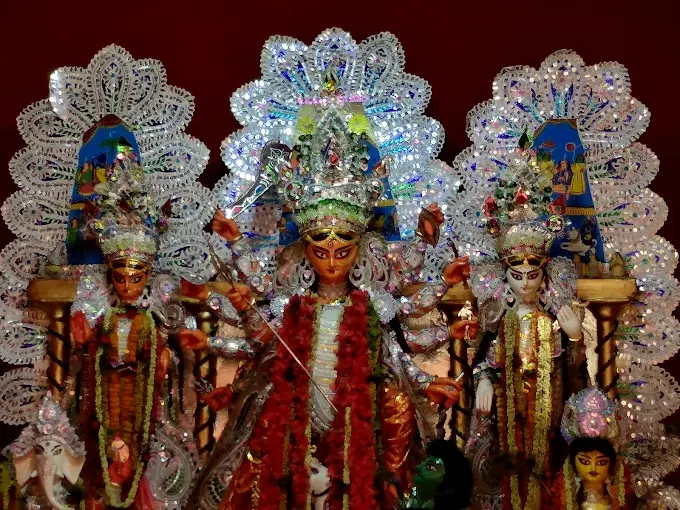
What makes this family extraordinary isn’t only their Puja’s age. The Saborna Roychoudhurys were the zamindars who, in 1698, leased three villages – Sutanuti, Gobindapur, and Kalikata – to the British East India Company. Those three villages eventually merged into the city we now call Kolkata. In other words, the family that started the city’s oldest Durga Puja is also, in a very real sense, connected to the city’s own founding story.

Eight Pujas, One Family

Over four centuries, the Saborna Roychoudhury family has grown into several branches, and the original Puja has multiplied into eight distinct celebrations – Atchala, Boro Bari, Mejo Bari, Benaki Bari, Kalikinkar Bhavan, and Majher Bari in Barisha, plus one each at Birati and Nimta. Each branch conducts its own rituals independently, yet all trace back to the same 1610 origin and follow shared customs passed down through generations.

Rituals Rooted in Scripture, Not Spectacle

Unlike the theme-based pandals that dominate modern Kolkata, the Barisha Puja is deliberately understated. The family follows rites laid out in the Durgabhaktitarangini, an old ritual text specific to their tradition. The idols are simple, traditionally crafted, and symbolic rather than ornate. Animal sacrifice was discontinued long ago, and on Navami, Kumari Puja is observed as part of the family’s core rituals. On Mahasashthi, the family also releases its own magazine, Sabarna Barta, at Kalikinkar Bhavan — a reminder that this is as much a living family institution as a religious event.

Visiting the Saborna Roychoudhury Barir Durga Pujo

The ancestral Atchala Bari and the family’s other puja houses are located in Barisha, South Kolkata, near landmarks like Barisha Club and Sakher Bazar – locals can easily point visitors in the right direction. The atmosphere is most vivid during the morning and evening aarti hours. Because this is a family residence and not a public pandal, visitors are encouraged to be respectful of the space and the rituals in progress.


Durga Puja: India’s Grandest Festival of Faith, Art, and Togetherness

Every autumn, as the sky turns a crisp blue and kaash phool (wild grass flowers) sway along riverbanks, Bengal and much of India come alive with the rhythm of dhaak drums and the scent of incense. This is Durga Puja — a festival that goes far beyond religious ritual to become a celebration of art, community, and homecoming.

What Is Durga Puja?

Durga Puja marks the victory of Goddess Durga over the buffalo demon Mahishasura, symbolizing the triumph of good over evil. Celebrated over five main days — Shashthi, Saptami, Ashtami, Navami, and Dashami — the festival typically falls in September or October, following the Hindu lunar calendar. In 2026, it’s expected to be celebrated in the last week of October.

While it holds deep spiritual meaning, Durga Puja is also a cultural extravaganza, especially in West Bengal, where it has been recognized by UNESCO as an Intangible Cultural Heritage of Humanity.

The Magic of Pandals and Idols

One of the most striking features of Durga Puja is the pandal — temporary, elaborately designed structures built to house the goddess’s idol. Cities like Kolkata transform into open-air art galleries, with pandals themed around mythology, social issues, historical monuments, and even global architecture. Skilled artisans from Kumartuli, Kolkata’s traditional potters’ quarter, spend months sculpting clay idols of Durga, flanked by her children Lakshmi, Saraswati, Ganesha, and Kartikeya.

Visiting pandals, known as “pandal hopping,” is a beloved tradition where families and friends stroll through the city late into the night, admiring the artistry and enjoying street food.

A Festival of Food, Fashion, and Family

Durga Puja isn’t just about worship — it’s a full sensory experience. New clothes, traditional dhoti-kurta and sarees, and vibrant makeup mark the celebratory spirit. Street stalls overflow with Bengali delicacies like kosha mangsho, biryani, and rosogolla. Cultural programs featuring dance, music, and theater fill community grounds, while dhunuchi naach — a traditional dance performed with burning incense pots — captivates crowds during Sandhi Puja.

For many, Durga Puja is also a time of reunion. Families travel long distances to be together, and the festival becomes a bridge connecting generations and diaspora communities across the globe.

Durga Puja Beyond Borders

Today, Durga Puja is celebrated with equal fervor in cities like Delhi, Mumbai, Bengaluru, and even internationally in London, New York, Toronto, and Dubai, reflecting the global footprint of the Bengali diaspora. Community associations abroad recreate the pandal experience, ensuring the festival’s spirit travels wherever Bengalis call home.

Why Durga Puja Matters Today

In a fast-paced, digital world, Durga Puja offers a rare pause — a time to reconnect with roots, community, and creativity. It supports local artisans, boosts tourism, and fuels a massive festive economy, often called the “Durga Puja economy,” contributing significantly to Bengal’s GDP each year.

Whether you’re drawn by devotion, art, food, or the joy of festivity, Durga Puja is a sensory and soulful celebration — one that beautifully blends tradition with modern life, making it one of the most anticipated festivals in India and beyond.